
Thought leadership and opinion pieces
Weekly newsletters
Latest edition
Published Wednesday, 7 October 2026 — curated from the week in broadcast and AI.
Executive Summary
The most consequential development this fortnight is Comcast's decision to make streaming technology cuts ahead of its acquisition of ITV. This move signals a strategic shift in resource allocation, potentially impacting operational efficiencies and content delivery for broadcasters and streamers. ProSiebenSat.1's launch of an HbbTV-based AdManager platform allows SMEs to independently manage TV campaigns, enhancing advertising accessibility and targeting capabilities. JioHotstar's expansion into the MENA region through a partnership with Starzplay demonstrates its aggressive international growth strategy, offering broadcasters in the region a new competitive dynamic. Lastly, ITVX surpassing three billion streams two months earlier than last year highlights the increasing consumer demand for streaming content, urging broadcasters to prioritize digital platform enhancements to capture audience interest.
Industry News
Algeria: Eutelsat renews TDA distribution Eutelsat has announced the renewal of its partnership with Télédiffusion d’Algérie (TDA), Algeria’s national broadcasting network operator. The partnership covers the continued distribution of television channels across the Middle East and North Africa (MENA) via the Eutelsat 7 West A satellite. This renewal ensures the sustained availability of Algerian content across the region, supporting broadcasters in maintaining their audience reach. Read more →
ProSiebenSat.1 launches HbbTV-based AdManager for SMEs German media company ProSiebenSat.1 has launched an HbbTV-based self-service platform that enables small and medium-sized businesses to plan and run addressable TV campaigns on connected TVs. The ProSiebenSat.1 AdManager empowers SMEs by providing them with tools to effectively reach their target audiences through personalized advertising, potentially increasing their market presence. Read more →
Ahead of ITV acquisition, Comcast makes streaming technology cuts According to Reuters, most of the cuts are at Sky, although some US-based NBCUniversal employees will also be impacted. This restructuring is part of Comcast's preparation for the ITV acquisition, aiming to streamline operations and reduce costs, which may affect content delivery timelines and quality. Read more →
JioHotstar extends to MENA with Starzplay India’s largest streaming platform, JioHotstar, is extending its international reach into the MENA regions. JioHotstar and its Starzplay partner used a CABSAT event at the Burj Khalifa to announce the service. This expansion follows its recent launches in the UK, Canada, and Singapore, indicating a robust growth strategy that broadcasters in the MENA region must consider in their competitive analysis. Read more →
SkyShowtime launches on Titan OS across Europe SkyShowtime has expanded its smart TV distribution through a partnership with independent connected TV platform Titan OS. The streaming service is now available on Titan OS-powered Philips and Sharp televisions, broadening its reach and accessibility across European households, which could enhance subscriber growth for the platform. Read more →
Technology Updates
Bauer Media ads inventory now on Amazon Ads Amazon Ads and Bauer Media have announced a partnership making Bauer Media’s audio ads inventory available to advertisers via Amazon Ads. Bauer Media’s audio portfolio, spanning Absolute Radio, KISS, Magic, Hits Radio, and Greatest Hits Radio, reaches 23.5 million weekly listeners in the UK. This collaboration offers advertisers a new channel to reach a vast audience through targeted audio advertising. Read more →
ITVX passes 3 billion streams two months earlier ITVX passed three billion streams for 2026 on September 9, reaching the milestone two months earlier than last year. ITV said its streaming service delivered more than one billion streams, underscoring the platform's growing popularity and the increasing consumer shift towards digital content consumption. Read more →
Bring the Sound: Host Broadcaster Aurora Brings Athlos London Audio all the Atmos, Music and Drama Athlos London, the all-female annual athletics competition, was available to view in more than 150 countries through the competition’s broadest global distribution network to date. This event showcased Aurora's capability to deliver high-quality audio experiences, enhancing viewer engagement through immersive soundscapes. Read more →
NHL, Gameday Creative Deliver National Polish With a Hometown Feel for New Graphics Package This season marks a new era for the NHL’s regional-production scene, with the league launching a centralized production operation that oversees local game and studio productions for six clubs. This initiative aims to standardize production quality while maintaining local flavor, potentially improving viewer experience and engagement. Read more →
Zixi, Grass Valley, Uplynk and BroadView Software set out IP framework for distribution The IP Convergence Framework for Distribution provides a practical, repeatable model for the transition from satellite distribution to IP. This framework offers broadcasters a structured approach to embrace IP technology, promising more efficient and scalable content distribution solutions. Read more →
Market Trends
SVG Sit-Down: iodyne’s Michael Gitig on Meeting a Team’s Rising Content-Delivery Demands The company’s Pro Data portable storage unit enabled the Dallas Cowboys production group to reduce late nights at training camp. With the NFL regular season now a month old, team production units are increasingly relying on efficient storage solutions to manage content delivery demands. Read more →
Exclusive: SDI remains primary infrastructure for broadcasters An industry survey from TVBEurope, TV Tech, and Caretta Research brings a reality check to IP transition in live production. Despite the push towards IP, SDI continues to be the primary infrastructure for broadcasters, indicating a slower than anticipated shift in technology adoption. Read more →
Apple TV bucks unscripted trend with premium content focus Apple TV is the only major global streaming service to have increased the proportion of scripted content in its US catalogue, according to new research from Ampere Analysis. While competitors focus on unscripted content, Apple TV's strategy highlights its commitment to high-quality scripted programming, potentially attracting a different viewer demographic. Read more →
Crowning Glory: Aurora on Creating Athletics for the Modern Age With the First London Athlos Athlos London reached 7.3 million viewers across its broadcast and streaming partners as it went live for one epic night of female athleticism from the StoneX Stadium. A sold-out crowd and significant viewership numbers underscore the event's success and the growing interest in women's sports. Read more →

Looking Ahead
ProSiebenSat.1 launches HbbTV-based AdManager for SMEs As ProSiebenSat.1's HbbTV-based AdManager gains traction, we can expect a shift in how SMEs approach television advertising. This platform democratizes access to TV ad space, potentially increasing competition and innovation in advertising strategies. Broadcasters should prepare for a more diverse range of advertisers entering the market. Read more →
Zixi, Grass Valley, Uplynk and BroadView Software set out IP framework for distribution The IP Convergence Framework for Distribution is poised to accelerate the industry's transition from satellite to IP. As broadcasters adopt this framework, they will likely experience enhanced distribution efficiency and reduced operational costs. This transition will be crucial for staying competitive in an increasingly digital-first environment. Read more →
Apple TV bucks unscripted trend with premium content focus Apple TV's commitment to scripted content could influence other streaming services to reconsider their content strategies. As Apple TV attracts audiences seeking high-quality narratives, competitors may need to balance their unscripted offerings with premium scripted content to retain and grow their subscriber base. Read more →
Ancast Intelligence — AI in broadcast consulting by Ben Anchor.
Curated articles
Analysis, updates and spotlights
Why I'm Done Chasing Deals at Trade Shows (And What I'm After Instead)
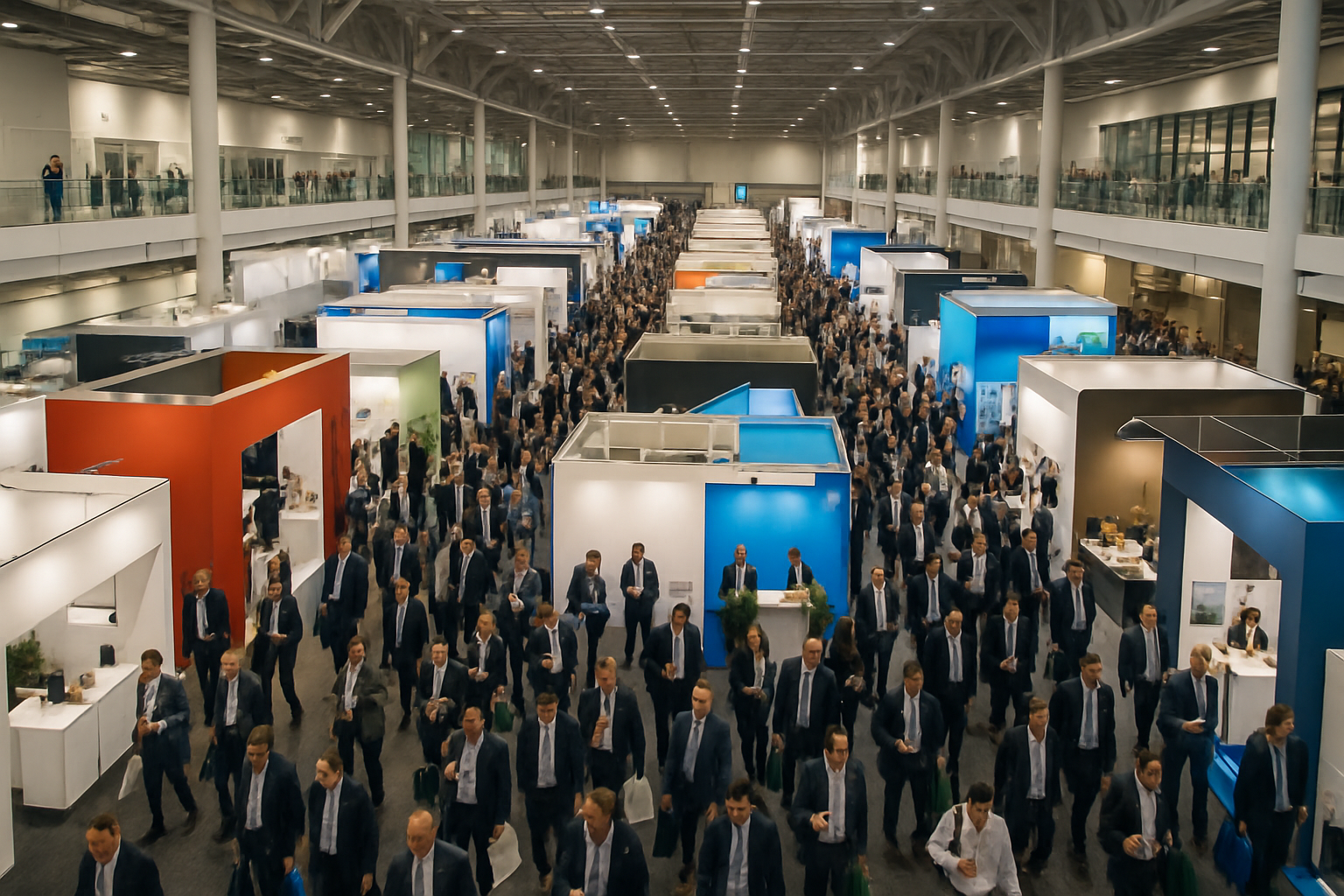
After years of lanyards, carpets, and expensive coffee, I've realised the real ROI from events isn't on the show floor—it's in what happens months later, when you've stopped trying so hard.
I've just spent a week in Nepal at a wellness-meets-ambition gathering with about 100 people, and in nine days I'll be standing in Amsterdam with 45,000 others at IBC. Same planet, wildly different planets.
One's got sunrise yoga and summit circles. The other's got branded lanyards and €8 espressos. Both are called 'events'. Both promise connections. And yet I'd wager most people book the wrong one, show up with the wrong expectations, and leave disappointed.
This bonus episode—recorded at Nomad Basecamp in Pokhara with investor Sheikh Saifudeen and e-commerce founder Biplab Karki—pulled apart that tension. We talked about reach versus peers versus procurement, about spiritual reprogramming and agentic commerce, and about why the hustle to close a deal on the stand is usually the least valuable thing you can do.
The Three-Way Split: Reach, Peers, Procurement
I floated a framework: talks are about reach (getting your message out), conferences are about peers (building your network), and trade shows are about procurement (doing deals). It's a tidy model. It's also probably wrong.
Sheikh's take was that people come to events—whether it's a spiritual gathering in the Himalayas or a procurement fair in Europe—to improve their lives. Maybe it's a single idea. Maybe it's a relationship. Maybe it's just permission to think differently. The form of the event matters less than whether you walk away with something that shifts your trajectory.
Biplab, who's been to startup expos across Asia, agrees it's mixed. An exhibition can yield clients or collaborators or just a better sense of what's happening in an adjacent industry. He went to a goods expo in Thailand not to buy anything, but to understand the economy and lifestyle. That's a peer move at a procurement event.
I think they're both right, and my neat categories are less useful than I'd hoped. But the underlying question stands: why are you there, and are you set up to receive what you actually need?
The Myth of the On-Site Close
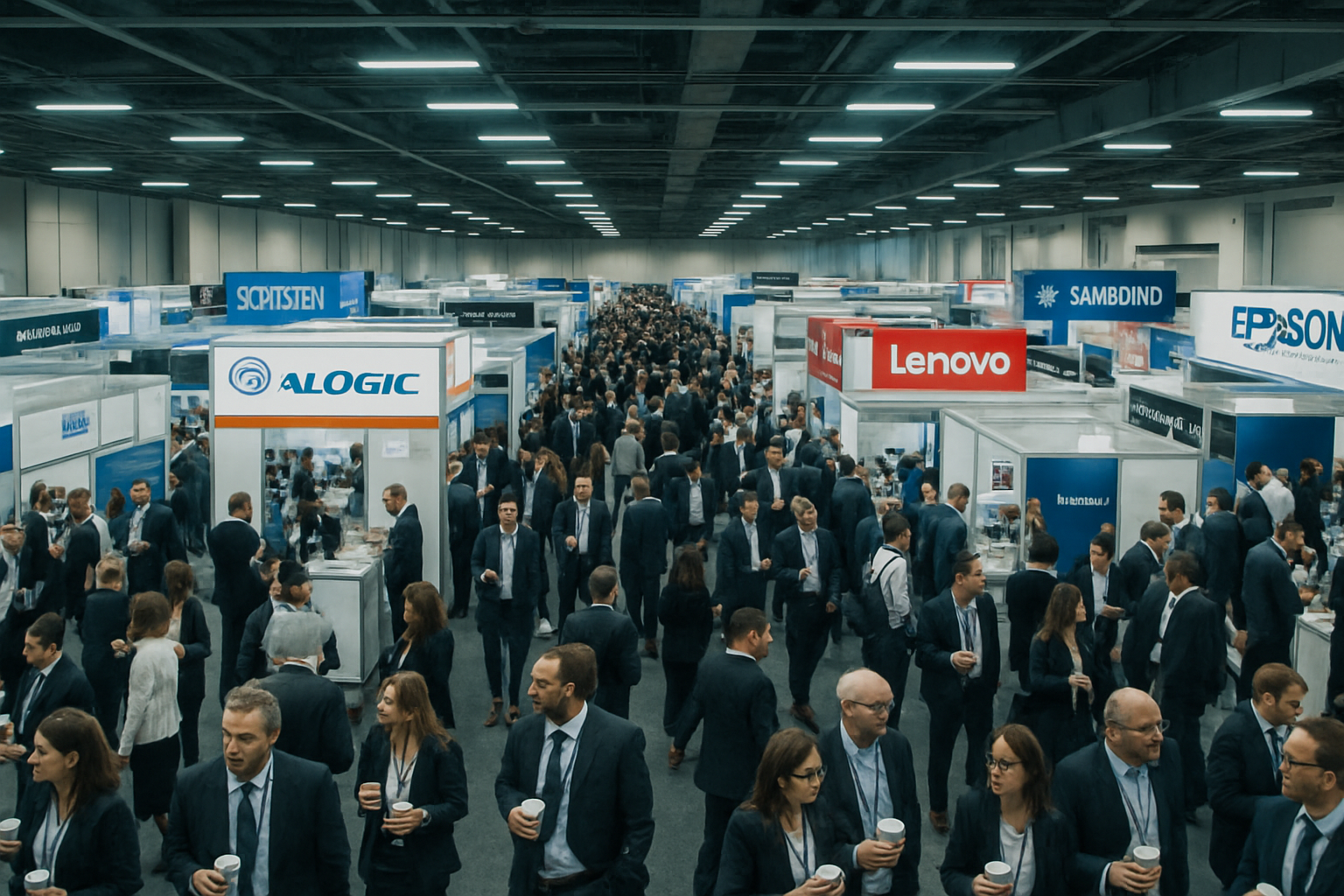
Ten years ago, I'd rock up to a stand with a target: X meetings, Y leads, Z closes. The pressure was real, especially if you'd spent five figures on the footprint. Sheikh's been on both sides—exhibiting for his own e-commerce business and working procurement for others—and he remembers that expectation to recuperate funds. But he's also clear: the most valuable thing was always the contact list. Emails. Ways to stay in touch. Because deals rarely close on the floor.
He reckons it takes five to nine touches before trust is built and a deal gets done. You meet someone, they get an email, maybe a follow-up, maybe they click through to your site. A few months later, when the need aligns, then they buy. The stand is just touch one.
Biplab frames it as ROI over time. You invest now—booth, travel, team—and you get direct ROI in three, six, twelve months. But you also get indirect ROI immediately: branding, content, social proof, understanding. If you're only measuring the former, you're missing half the value.
I've lived this. I've had conversations at IBC that led to nothing for two years, then suddenly the person's at a new company, remembers me, and we're in business. If I'd been fixated on closing them in Amsterdam, I'd have written them off as a waste of time. Instead, I stayed in touch, stayed useful, and let the relationship mature.
The insight: stop trying to force the close. Start collecting the threads.
AI as Co-Founder, Scheduler, Spiritual Advisor
We pivoted to AI, because it's what the main podcast is about and because both guests had strong views. Biplab's building an agentic commerce platform—think AI agents running your e-commerce ops, talking to your ERP, optimising your supply chain. He reckons you could halve your headcount and double your efficiency. Bold claim, but the trend's real. Google's betting on it. So are a dozen well-funded startups.
Sheikh uses AI differently. He's plugging his thoughts, goals, and internal blocks into a model and treating it like a personal advisor. Not just for business strategy, but for subconscious reprogramming. He's asking: where am I limiting myself? What beliefs are holding me back? What do I need to shift internally before I take the next leap? It's consciousness work, but with a chatbot.
I loved that framing. AI as the best on-demand co-founder, consultant, and therapist rolled into one. It sees what you can't see—or at least, it mirrors back patterns you've been too close to notice.
For me, the next 12 months are about taking that idea into broadcast scheduling. I'm building Ancast Nowcasting: a custom model that doesn't just learn from a broadcaster's historical data, but ingests live public signals—search trends, social media, cultural moments—to give schedulers a superpower. Not an LLM wrapper. A genuinely new intelligence layer. I'm at IBC to talk about it, then South Africa, then the Middle East. This time next year, I want pilot studies done and proof of concepts in production.

What I'm Taking Away
Three things stuck with me from this conversation.
First, events are format-agnostic when it comes to value. A 100-person basecamp and a 45,000-person trade show can both deliver life-changing connections—or neither. It's not about the carpet or the catering. It's about what you're open to receiving.
Second, ROI is a lagging indicator. If you're measuring success by what happens at the event, you're looking at the wrong timeframe. The real return shows up months later, when the trust compounds and the timing aligns.
Third, AI is only as good as the questions you ask it. Whether you're using it to optimise a supply chain, reprogram your subconscious, or build a nowcasting engine for schedulers, the magic isn't in the model—it's in how clearly you've defined the problem.
I'll be in Amsterdam from the 11th. If you're there and want to talk broadcast AI, Nowcasting, or just compare notes on trade show coffee, book a slot. I won't try to close you. I'll just collect the thread.
And maybe, in six months, we'll both be glad we did.
Ancast Intelligence — AI in broadcast consulting by Ben Anchor.
The Accountable Human: Why AI Cinema's Real Story Isn't the Slop, It's the Signature
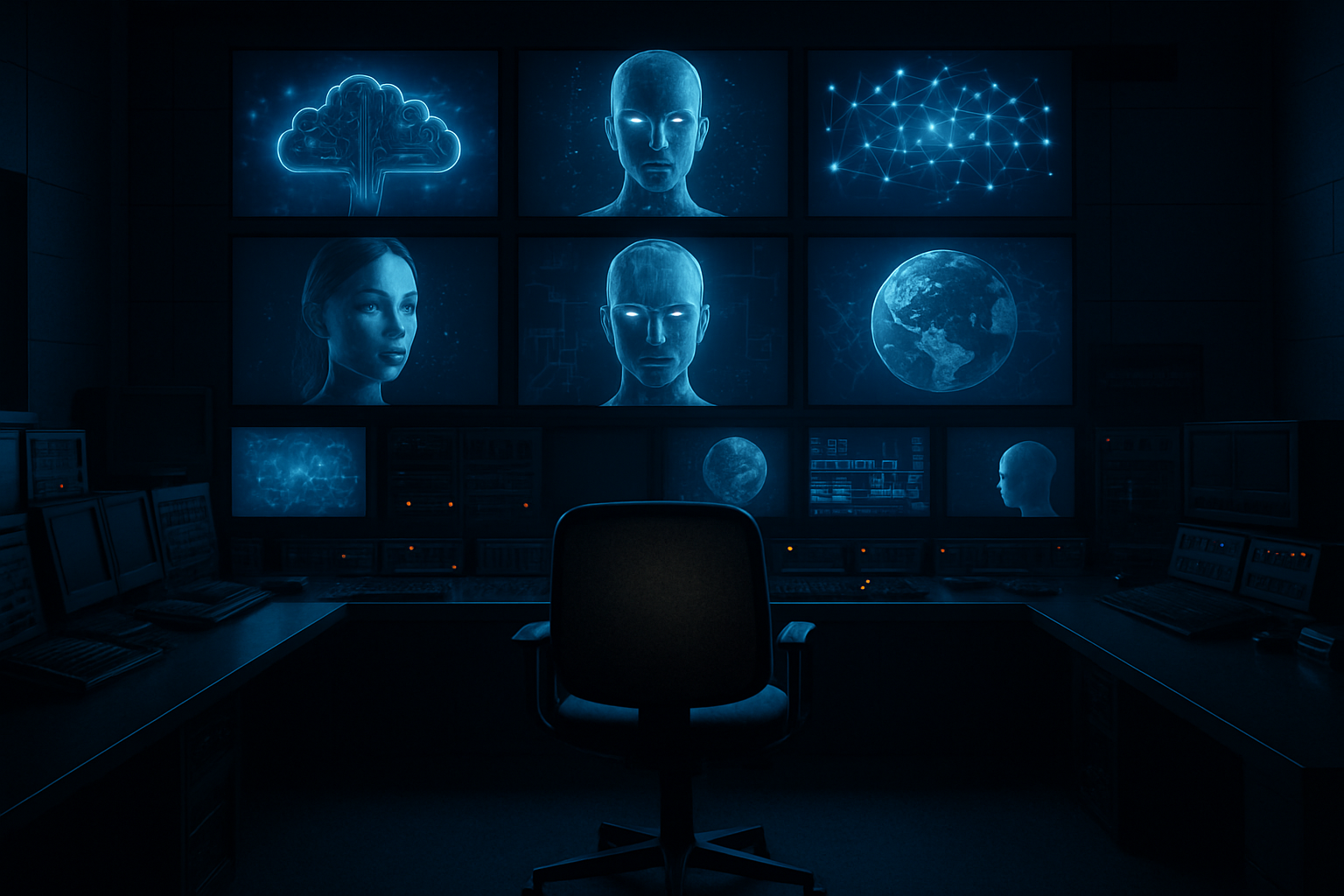
Fairground AI's generated channel launched to brutal reviews—and that's beside the point. The real shift is infinite supply hitting fixed demand, and it points straight at a question most of us are ignoring: when the machine does the work, who's left holding the pen?
On 13 August this year, the first fully generated television channel went live on Roku. Within 48 hours, the internet had christened it 'AI slop.' I'll be honest—my first reaction matched theirs. My second reaction, about a day later, was that arguing over the quality misses the entire story.
The channel is called Fairground AI Creator TV. Every frame is generated. No actors, no crew, no shoot. It looks like a channel, it schedules like a channel, it sells ads like a channel. And yes, if you sit and watch it, the failure modes are exactly what you'd predict: faces that drift between shots, physics that's nearly right (and therefore worse than obviously wrong), and a total absence of the thing that makes narrative work—a scene built because somebody wanted it to mean something.
But here's why I don't want to spend this article on that, and it's the same reason I wouldn't have spent one in 1999 explaining that video on the internet looked terrible. Of course it did. The quality of the first version has almost no predictive value. What has predictive value is the cost curve underneath it.
The Economics Are the Story
Free ad-supported television is brutally tight. You make money on advertising against watch hours. The rates are low, so the entire business is a race between the cost of filling 24 hours a day and the revenue those hours can generate. Which is why the free streaming ecosystem is largely built on library content—formats nobody's licensing at a premium any more, back catalogue, the stuff whose marginal cost of re-airing is close to nothing.
Now watch what generated content does to that equation. It doesn't lower the cost of content. It removes the floor entirely. No acquisition, no rights window, no residuals, no revert. If your channel costs almost nothing to fill and it earns even a small amount, it's profitable on day one—and it's profitable at a scale of one channel or 1,000 channels.
That's the bit that matters, not the quality. The fact that the supply side has become effectively infinite while the demand side—which is human attention in the evening—has not moved at all.

Infinite supply against fixed demand is not a technology story. It's a pricing story, and it points in one direction. If the amount of watchable material goes up by orders of magnitude and the number of hours in an evening does not, then the value of any individual hour of content falls. Not the value of the best hour—the value of the average hour. And most of our industry is not in the business of making the best hour. Most of our industry is in the business of reliably making the average one, on schedule, on budget, to a standard. That's where the employment is.
So the honest read is not that generated content will replace prestige drama. It's that it competes directly with the enormous middle of the market: the filler, the acquired formats, the daytime, the things that exist because the schedule has to be filled. And that middle is where a very large number of people in this industry actually work.
The Company That Runs Itself
This connects to a claim I heard at an AI summit recently: that within roughly 18 months, we'll see a genuinely autonomous company. Not a company that uses AI—a company where the agents do the work end to end. They find the customer, they make the thing, they invoice, they handle the support ticket, they file the accounts. No human sits in the loop on any given day. The summit framing is quite specific about the stages: you go from co-pilots (where most organisations actually are) to agents doing bounded tasks, to autonomous workflows that run without a person initiating them. The end state they describe is an organisation chart with nobody on it.
My instinct is that this is the same species of claim as the fully automated newsroom, which has consistently failed to arrive. But the evidence is genuinely split. Task-specific agents went from under 5% adoption last year to a forecast of around 40% by the end of this year. Something close to three-quarters of businesses say they intend to deploy agents inside that window.
Against that: over 40% of agentic AI projects are forecast to be cancelled before the end of next year on cost and on unclear business value. So the picture is not a straight line up. It's a very large number of organisations starting, and a very large number of them stopping.
But there's a harder objection than cost. A company is not just a set of tasks. A company is a legal thing. Who signs?
The Wall
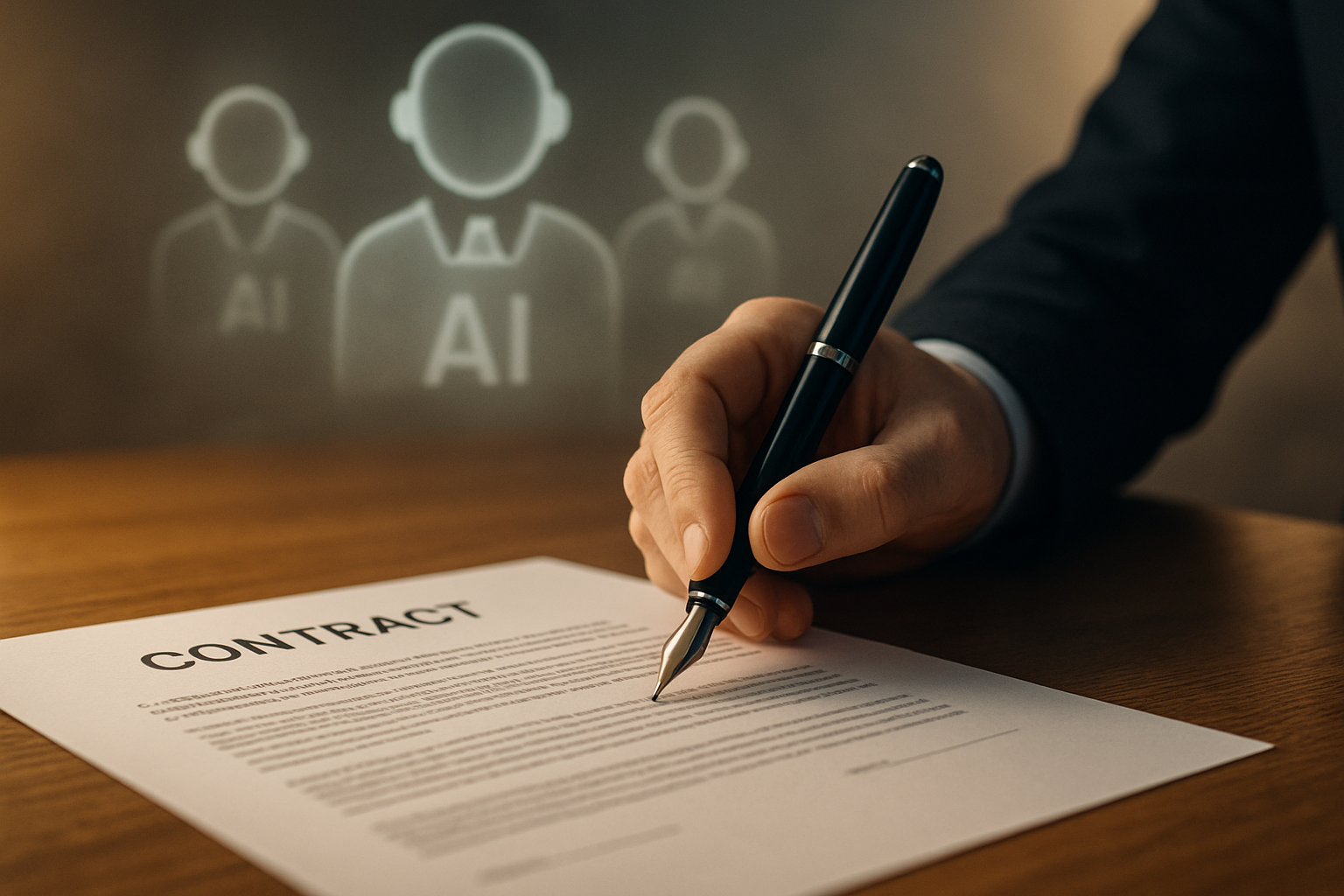
This is the wall, and it's the most useful thing in this entire conversation. A model can execute the work of a business. It cannot be the business. Legal personhood requires a person or a registered entity. A bank account requires a legal owner. A contract requires a party that can be sued. So every one of these so-called zero-human companies, when you look underneath, is running inside somebody's limited company with a director, and that director is on the hook.
The machine executes. The human signs.
Which means the 18-month claim, in the form it's usually made, is not wrong so much as it is misdescribed. What's arriving is not a company with no humans. It's a company with one human, whose entire remaining job is accountability.
And that's our world exactly. A broadcaster is not a set of tasks either—it's a licence. Somebody holds the licence; that somebody answers for what went out. It doesn't matter whether a person, a playout automation system, or a generative model put the frames on the air. It doesn't transfer to a vendor because you bought a tool, and it doesn't transfer to a model because the model made the choice.
So take that AI-only channel and ask the question that nobody in the coverage asked: if it broadcasts something defamatory, who is liable? Not the model. Not the creator who typed the prompt, probably. The entity that published it—which is a company with directors, with a registered address, sitting behind $4 million of venture funding.
The channel has no people in it. The business absolutely has people on the hook.
What to Actually Do
Somebody running a media operation hears all this on a Monday morning. What do they actually do?
Three things, and none of them are glamorous.
First, be extremely honest about which part of your output is the middle of the market. If a meaningful share of what you make exists to fill a schedule rather than to be sought out, that's the part exposed to infinite supply, and you should be planning for it now rather than being surprised by it in two years.
Second, stop evaluating this on quality and start evaluating it on cost per hour, because quality is the variable that moves fastest and cost is the one that decides.
Third, and this is the one I'd actually act on this week: write down where accountability sits in every automated process you already run. Not where the technology sits—where the signature sits. Because the organisations that will handle the next three years well are not the ones with the best models. They are the ones that can answer, instantly and in writing, the question of who is responsible when it goes wrong.
That's the thing the machine cannot take from you, and it's also the thing that quietly turns out to be the job.
My Honest Prediction
I think we'll absolutely see a business that operates with no staff and generates real revenue, and I think it will happen sooner than 18 months, because in a narrow enough niche it has arguably happened already. What we won't see is a company without a person who answers for it, because that's not a technology problem—it's a law problem, and the law is not moving at the speed of the models.
So the channel with nobody in it still has somebody behind it. It always did. And the question worth asking, about any of this, in our industry or anyone else's, is not what the machine can now do. It's who's standing there when it gets it wrong.
Ancast Intelligence — AI in broadcast consulting by Ben Anchor.
Contact
60 Tottenham Court Road, Suite 5614a
Fitzrovia, London W1T 2EW, UK
contact@ancast.co.uk